Home / Financial / Interest Calculator
Enter your values and click Calculate to see your result.
Interest is the price of using someone else’s money — or the reward for letting someone else use yours. When you borrow, interest is the extra amount you pay on top of what you borrowed. When you save or invest, interest is the extra amount the bank or the market pays you. Either way, the same three things decide how much interest appears: how much money is involved, the rate, and how long the money sits. This free interest calculator works it out for both sides of that deal — savings that grow and loans that cost — including regular contributions, taxes on the interest you earn, and the way inflation quietly eats into what your money can buy.
How to Use This Interest Calculator
Start with the initial investment: the lump sum you put in on day one. If you are working out a loan instead, think of this as the amount borrowed. Then add the annual contribution and the monthly contribution — the money you plan to add regularly. If you only add money once a year, put the monthly contribution at 0, and the other way round. The “contribute at the” box decides whether each contribution goes in at the beginning of its period, so it earns interest right away, or at the end, so it earns nothing until the next period. Beginning is the default, because most people deposit and then let the money work.
Next, enter the annual interest rate and choose how often it compounds — annually, semiannually, quarterly, monthly, weekly, daily, or continuously. Then set the investment length in years and months. The tax rate is the share of your interest income that goes to tax each year; leave it at 0 for a quick, tax-free estimate, or enter your marginal rate for a realistic after-tax figure. The inflation rate adjusts the final number into today’s buying power, so you can see what the ending balance will actually be worth. Press Calculate and you will see the ending balance, the total principal, the total contributions, the total interest, how much of that interest came from the starting amount and how much from the contributions, and the inflation-adjusted buying power — plus a year-by-year accumulation schedule. In short, an interest calculator turns a starting amount, regular contributions, a rate, and a time period into the final balance and the interest earned along the way.
Simple Interest vs. Compound Interest
There are two distinct ways interest can pile up. With simple interest, you earn interest only on the original amount, never on the interest itself. Borrow $100 for one year at 10%, and you owe $10 of interest, so you repay $110. Borrow it for two years at the same simple rate, and you owe $10 for the first year and $10 for the second — $120 in total. The formula is short and honest: interest = principal × rate × time. Simple interest still shows up in some short-term loans and car finance, but it is rare in savings and investing, because almost every bank and investment account compounds.
With compound interest, each period’s interest is added to the balance, and the next period’s interest is charged on that bigger balance — interest earns interest. Borrow that same $100 for two years at 10% compounded annually, and the first year still costs $10, taking the balance to $110. But the second year’s interest is 10% of $110, which is $11, so you repay $121 instead of $120. That extra $1 is small here, but stretch the same idea over twenty years and the gap becomes enormous. The chart below shows $1,000 growing at 20% for twenty years: compounded annually it reaches $38,338, compounded monthly $52,828, compounded daily $54,538, and compounded continuously $54,598. The rate is identical in all four lines — only the frequency changes, and the lines still split apart by thousands of dollars.
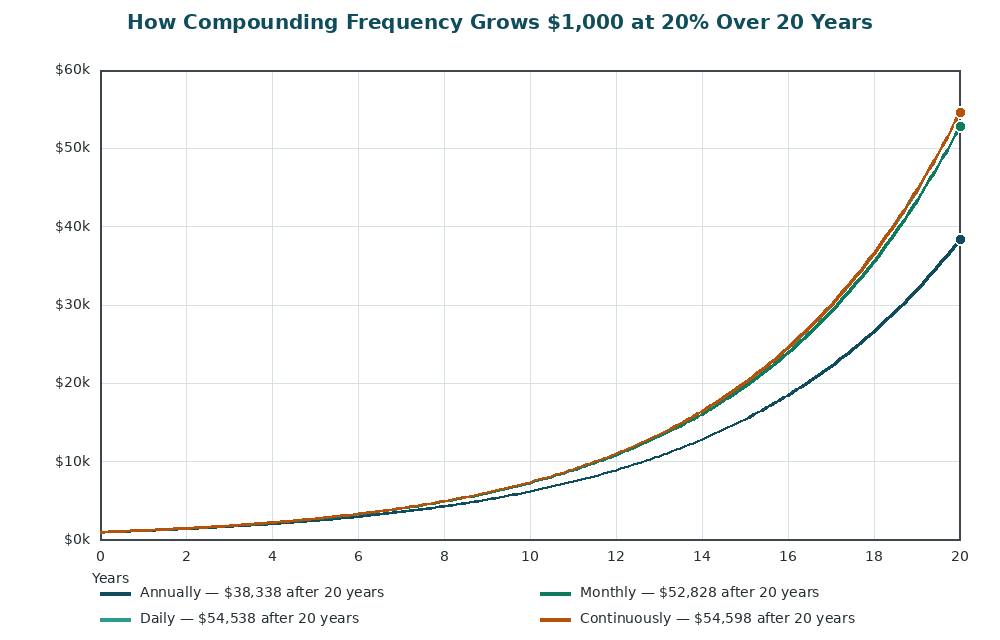
The lesson is simple: the more often interest compounds, the faster money grows — or, on a loan, the faster the cost climbs. Daily compounding beats monthly, monthly beats annual, and continuous compounding, which uses the mathematical limit of ever-shorter periods, beats them all, though only by a whisker over daily. That is why the compounding frequency is worth checking on any savings account or loan, not just the headline rate.
The Rule of 72
If you want a quick estimate without a calculator, the rule of 72 is the oldest shortcut in finance. Divide 72 by the interest rate, and the answer is roughly how many years it takes your money to double. At 8%, money doubles in about 72 ÷ 8 = 9 years, so $1,000 becomes $2,000 in nine years. At 6%, it takes about 12 years; at 12%, about 6 years. The rule works best for rates between 6% and 10%, and it is an estimate, not an exact figure — but it is close enough to compare two offers in your head before you sit down with the real numbers.
The Interest Formulas
Simple interest is interest = P × r × t, where P is the principal, r is the annual rate as a decimal, and t is the time in years. Compound interest on a lump sum is A = P × (1 + r ÷ n)n×t, where n is the number of compounding periods per year. With continuous compounding, the formula becomes A = P × er×t, where e is Euler’s number, about 2.71828. When you add regular contributions, each contribution grows for a different length of time, so the calculator adds them period by period instead of using one closed formula — that is also how it handles contributions at the beginning versus the end of each period, and how tax is applied to the interest as it accrues.
Worked Example: $20,000 Plus $5,000 a Year at 5%
Take $20,000 invested today, with $5,000 added at the start of each year, earning 5% compounded annually for five years. In year one, the $5,000 joins the $20,000, so $25,000 earns 5%, which is $1,250 of interest, ending the year at $26,250. Year two adds another $5,000 and earns $1,562.50, ending at $32,812.50. Year three ends at $39,703.13, year four at $46,938.28, and year five at $54,535.20. The total principal is $45,000 — the $20,000 start plus five contributions of $5,000 — so the total interest is $54,535.20 − $45,000, which is $9,535.20. Of that, $5,525.63 came from the starting $20,000 growing alone, and $4,009.56 came from the contributions. With inflation at 3%, that $54,535.20 buys what $47,042.54 buys today. Try the same numbers in the calculator above and you will see every figure match, including the year-by-year schedule.
Ending Balance on $20,000 Over 5 Years, No Contributions
The table below shows what $20,000 becomes after five years of annual compounding at different rates, with no contributions at all. The rate is the single biggest lever you control.
| Annual Rate | Ending Balance | Interest Earned |
|---|---|---|
| 3% | $23,185.48 | $3,185.48 |
| 5% | $25,525.63 | $5,525.63 |
| 7% | $28,051.03 | $8,051.03 |
| 10% | $32,210.20 | $12,210.20 |
Moving from 3% to 10% more than triples the interest earned on the same $20,000 over the same five years. That is why comparing rates matters more than picking the perfect contribution schedule, and why our compound interest calculator is worth a look if you want to focus purely on growth without tax and inflation, while our loan calculator shows the same maths from the borrower’s side, as a monthly payment.
Fixed vs. Floating Interest Rates
The rate on a loan or a savings account can be fixed or floating. A fixed rate stays the same for the whole term, so the numbers this calculator produces are exactly what you will get. A floating rate moves with a reference rate, such as the US Federal Reserve funds rate, so the real outcome can drift above or below the estimate. Floating-rate loans are usually a little cheaper at the start, and floating savings rates a little lower, because the bank passes the movement risk to you. This calculator deals with fixed rates only — if your rate floats, run the numbers at the lowest and highest rates you expect, and treat the truth as somewhere in between.
Tax and Inflation: The Two Quiet Deductions
Interest income is taxable in the United States — corporate bonds, savings accounts, and certificates of deposit all generate interest that the taxman counts, though some types, like interest on federal Treasury bonds, escape state and local tax. Tax applies to the interest as it is earned, year by year, which quietly slows the compounding: at 6% for twenty years, $100 grows to $320.71 tax-free, but with a 25% marginal tax rate it reaches only $239.78. Inflation is the second deduction. Prices in the US have risen by roughly 3% a year on average over the past century, so a fixed sum buys less every year. Tax and inflation together mean that money has to earn about 4% a year just to hold its real value for a middle-income saver — and anything above that is the true gain. That is why this calculator shows the buying power figure alongside the headline balance: the balance is what you will have, and the buying power is what it will be worth.
What This Calculator Does Not Cover
This tool assumes a fixed rate, regular contributions of the same size, and no withdrawals. It does not model variable rates, lump-sum withdrawals, fees, or the different tax treatment of retirement accounts such as 401(k)s and IRAs, where tax is deferred or waived entirely. It also does not predict investment returns — a stock market return is not interest, and it can fall as well as rise. For planning purposes, the figures here are estimates: your bank or lender’s final numbers, including any fees, are the ones that count. If you want the broader picture of what interest means in economics and history, the Wikipedia article on interest is a good place to start.
Run your own numbers above, try a higher rate and a longer term, and watch how quickly the interest column starts to do the heavy lifting.