Home / Fitness & Health / BMI Calculator
Units:
ft in
lb
Body mass index, or BMI, is a quick number that compares your weight to your height and gives you a rough sense of where you stand. It takes less than a minute to work out, and all you need are two numbers you probably already know. Try it above, then read on to see what your result actually means.
How to Use This BMI Calculator
Pick your units first. For US units, leave the US option selected and type your height in feet and inches, then your weight in pounds. For metric, switch options and enter your height in centimetres and your weight in kilograms. Press Calculate and your BMI appears, with its category and the weight range that counts as healthy for your height.
For the best result, weigh yourself in the morning before breakfast, in light clothing, and measure your height standing straight against a wall. Even half an inch of error can shift your BMI by a few tenths. If you track your weight over time, try our age calculator too — handy for logging progress by age.
What Is BMI?
BMI stands for body mass index: a single number, worked out from height and weight, that doctors and health organisations use as a fast screening tool. It does not measure body fat directly, and it cannot tell muscle apart from fat, but it gives a useful first signal — a very low or very high number is worth a closer look. Because it needs only two measurements, it is used worldwide, from routine check-ups to large public health studies.
The idea is simple. Weight alone tells you little — 180 pounds means something different at 5 foot 4 than at 6 foot 4. Dividing weight by height squared adjusts for that, so the number is comparable between people of different heights, which is why the same four bands apply to most adults.
The BMI Formula
In metric units, the formula is:
BMI = weight in kilograms ÷ (height in metres × height in metres)
In US units, because pounds and inches do not line up as neatly, the formula uses a conversion factor of 703:
BMI = 703 × weight in pounds ÷ (height in inches × height in inches)
Both versions give the same answer for the same measurements. The calculator above does the conversion for you, so you never need to remember the 703 or convert feet to inches by hand.
Worked Example
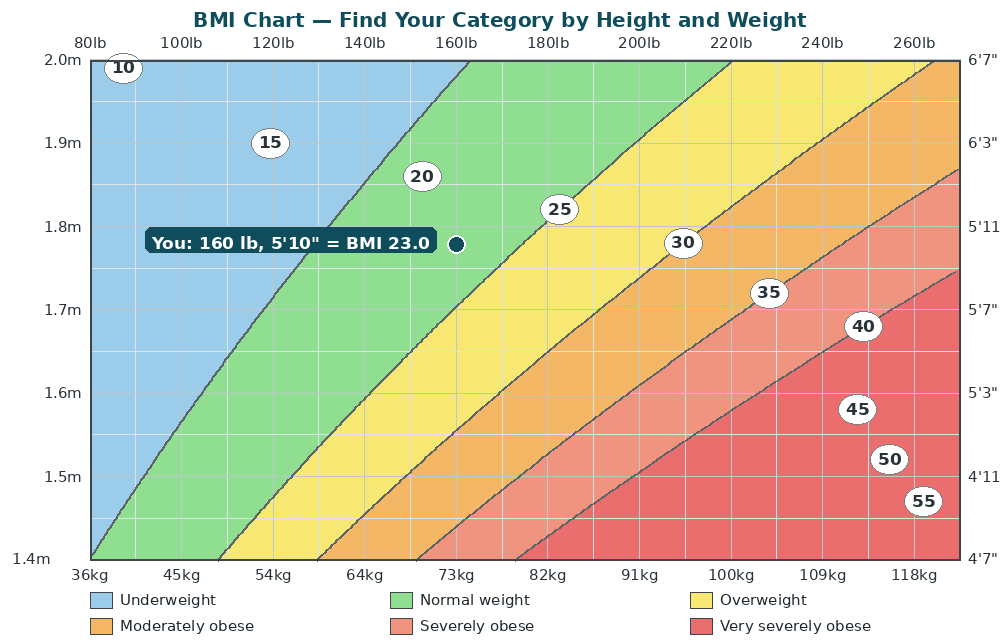
Take a person who is 5 feet 10 inches tall and weighs 160 pounds. First, turn the height into inches: 5 × 12 + 10 = 70. Then apply the US formula: 703 × 160 ÷ (70 × 70) = 112,480 ÷ 4,900 = 22.96, which rounds to a BMI of about 23.0 — normal weight.
The healthy weight range for that height comes from the edges of the normal band, 18.5 and 24.9. Height in metres is 70 × 0.0254 = 1.778 m. The lower end is 18.5 × 1.778² = 58.5 kg (about 128.9 lb) and the upper end is 24.9 × 1.778² = 78.7 kg (about 173.5 lb). So for someone 5 foot 10, roughly 129 to 173.5 pounds is the range linked to the lowest health risks.
BMI Categories at a Glance
| BMI | Category | What it generally means |
|---|---|---|
| Below 18.5 | Underweight | Low for the height; worth checking with a doctor. |
| 18.5 – 24.9 | Normal weight | In the range linked to the lowest risk for most adults. |
| 25.0 – 29.9 | Overweight | Above the healthy range; modest changes can help. |
| 30.0 and above | Obese | Well above the healthy range; a doctor can advise. |
For most adults, a BMI between 18.5 and 24.9 counts as normal weight and is linked to the lowest risk of weight-related health problems. Anywhere inside the band is fine — your ideal point depends on your build, age, and overall health.
These cut-offs come from the World Health Organization and are the standard bands used in the United States. You can read more about how they were set on Wikipedia's body mass index page.
Children's BMI is compared against growth charts for their age and sex, because healthy weight changes a lot as they grow. This calculator uses the adult categories, so it is for adults aged 20 and over.
Tips and Limitations
BMI is a screening tool, not a diagnosis. It works best for most adults, but it has blind spots: athletes and weightlifters often score as overweight because muscle is heavy, even with low body fat, and older adults can have a normal BMI while carrying more fat and less muscle. The number also means something different during pregnancy or with conditions that affect weight, such as fluid retention.
Use your result as a starting point, not a verdict. If your BMI sits outside the normal range, the practical next step is usually simple: look at your eating habits, daily movement, and sleep, and talk to a doctor if you want a fuller picture — they can measure body fat, waist size, and blood pressure alongside BMI. A single reading is only a snapshot, too: weighing yourself weekly under the same conditions tells you far more than one number on one day. If percentages come up while you work through health or fitness numbers, our percentage calculator handles those in a few clicks.
BMI is accurate as a population-level screening tool, and a reasonable first check for most individuals. It is not a direct measure of body fat, so it can mislead for very muscular people, older adults, and children. If your result surprises you, a doctor can confirm it with waist circumference or body fat percentage.
Once a month is plenty for most people when it comes to checking BMI. Weight naturally moves up and down by a pound or two day to day, so weekly or monthly checks under the same conditions — same scale, same time of day — show a clearer trend than daily ones.
Your BMI is one small number in a much bigger picture — a nudge to check in with your health, not a grade. Run the calculator, note your range, and take the next step that makes sense for you.